
What Video Marketing Actually Means for Founders
As a Founder you probably know a thing or two about marketing.
But add the word “video” in front of it, and suddenly you’re in another realm.
Equipment, editing, hooks, thumbnails, short-form, long-form, b-roll, the dreaded talking to camera.
But while it’s easy to find endless advice on topics like “how many videos you should post a week” – much of it conflicting by the way, few people take the time to actually understand video marketing, and in particular, how founders can be use it for their commercial benefit.
Because while creating videos can be fun, we aren’t doing it for fun.
So let’s go back to the very beginning, and get on the same page about what video marketing is, actually.
What is Video Marketing?
Marketing, very broadly, is the activity of understanding your audience, promoting your business and finding buyers for your products or services.
So Video Marketing is simply any marketing activity where the medium you’re using is video.
Here’s a few examples of video marketing:
- A meta video ad
- A service explainer
- A Founder story video
- A client testimonial
- A free webinar
- And then the one everyone thinks of when thinking of video marketing: social media video.
Marketing Videos vs Video Content
Any video created for Marketing purposes is technically a Marketing Video and a large part of that is Video Content, but video content doesn’t always feel like marketing, so I think it helps to seperate them.
Marketing Videos are generally one-off projects created for a specific purpose, like increasing enquiries from your homepage. You might create the video once and give it a permanent placement or it might be part of a larger campaign.
Video Content, on the other hand, is generally something you’re creating and publishing on an ongoing basis to create awareness, grow and engage an audience and give people a reason to pay attention.
Video content, like the other types of content marketing, is about providing value, so it doesn’t tend to be overly promotional, and it doesn’t always have a direct call-to-action. But it is important, because it’s how you build an online audience organically.
Where does video fit into Content Marketing?
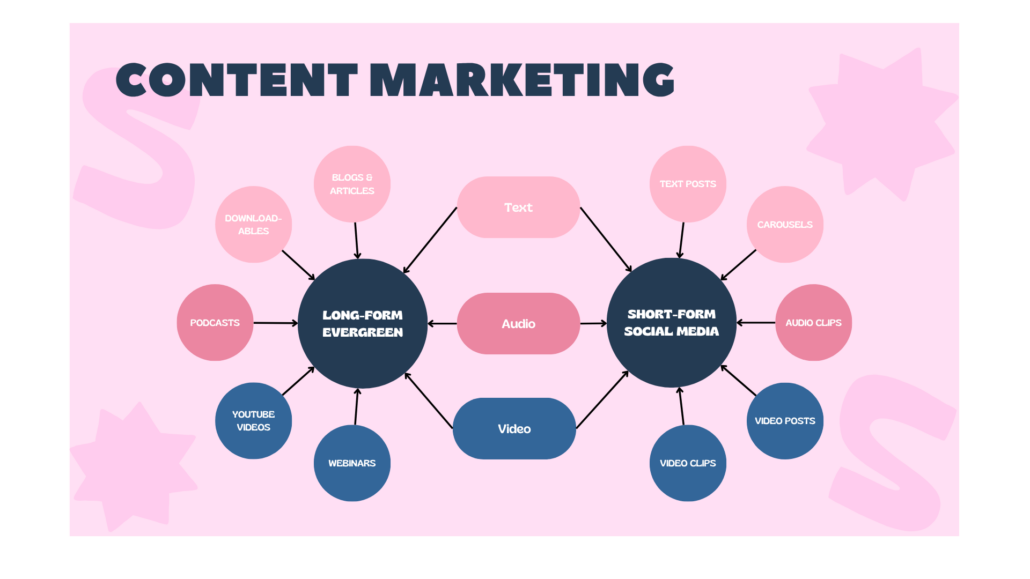
Ther are three main types of content: Text-based, audio and video.
Text-based content includes things like social posts, email newsletters, blogs and articles.
Audio content is podcasts and other audio tracks.
And Video Content includes social videos, video podcasts, educational videos etc.
You can use video alongside other types of content, or make it the main way you create and share content.
Either way, it should be thought of as part of your wider Content Marketing rather than as a completely standalone activity.
Short-form and long-form video
If you’ve done any Content Marketing before, you’ll know it tends to get separated into short-form and long-form content.
Video Content works in much the same way.
Short-form Video is mainly the videos you publish into social media feeds. They’re designed to be consumed quickly (and in quick succession with other people’s content), making them useful for visibility, getting in front of your existing audience and reaching new audiences.
Long-form Video is mostly video you publish onto websites and content-sharing platforms. In this case, people have made an intentional decision to watch and have arrived there through search, clicking or opting in, making it useful for going deeper into a subject, building trust and moving your audience towards your paid offers.
There’s no particular length at which a video suddenly becomes “long-form.” It’s more useful to think about how and where the video is being consumed.
The two can also work together. A longer video can give you material to turn into shorter videos, while short-form videos can introduce people to your ideas and give them a reason to seek out your longer content.
But you don’t necessarily need both. Short-form can lead straight to your business, and long-form can be discovered through search or recommendations.
The right mix depends on your business, your audience and your resources.
Using Video Elsewhere in Your Business
Video creation isn’t just for marketing. There’s loads of other places you can use video to add value for your business, such as:
Lead magnets – free training, webinars and other video resources used to generate leads
Delivery of services – coaching calls, consultations, live training
Sales – personalised videos, proposals and demonstrations to help convert prospects
Customer communications – onboarding, updates, instructions and support
Internal communications – company updates, presentations and messages to your team
Training – teaching employees, customers or clients how to do something
Products and services – online courses, coaching resources, memberships and other paid-for video content
Once you’ve developed the skills to create good video, you can apply them across all of these areas.
So, how should Founders use Video Marketing?
There’s a lot you could do with video, but that doesn’t mean you need to do all of it, especially all at once.
The best place to start is with what you’re trying to achieve in your business and what’s currently a priority, then work backwards from there. For example:
If you need to explain your business better or increase conversions, you might need to create specific Marketing Videos.
If your priority is becoming more visible and building an audience, you’ll probably want to focus on Video Content.
And if you’re already creating content, you can look at how you signpost between your short-form, long-form and business offers.
The point is to be intentional about the videos you create, so they actually work for your goals, and don’t just drain your time.
Next, it’s time to figure out:
The 3 Video Setups You Need to Sort – what you need to record them
The 4 Types of Video to Make as a Founder – what videos you actually need to make
6 Ways to Record Talking Videos – how you can get what you know on camera